Tell us about the job
Takes about a minute. No obligation.
A contractor quoting a central AC repair in San Francisco County has to settle one question before anything else: why did a system fail when it was barely used? Homes in San Francisco County, CA have essentially no cooling season — no month of the year is warm enough to call for it. A compressor that rarely starts accumulates almost no run-cycle wear, so corrosion, capacitor decay, and manufacturer defects become the likeliest causes of a breakdown. The contactor and the fan motor sit idle long enough that the first call of a rare warm spell finds them in unknown condition. That shifts what a contractor examines first away from worn running gear and toward the parts that degrade on the shelf.
Half the homes in San Francisco County, California were built in 1946 or earlier (2020-2024 ACS 5-year). A house that old has had its mechanical systems changed out at least once, often more. What a contractor finds when they open a central AC unit in this county is not a settled question: the system running today may be two or three generations removed from what the house was built for, and the parts it takes may sit at the edge of what suppliers still stock. When a repair turns on a failed component, the contractor has to confirm availability before the scope is set.
The Parts of a Central AC a Contractor Checks During Repair
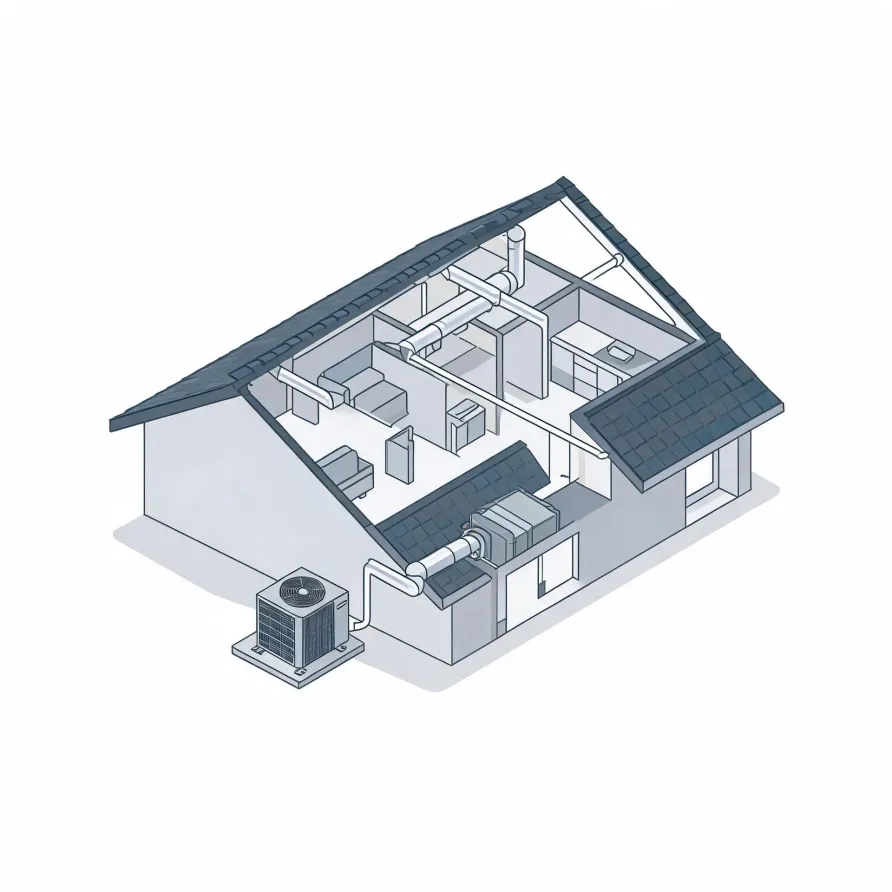
The outdoor condenser unit sits outside the house, usually on a concrete pad along a side or rear wall, and it holds the compressor and the condenser coil. These are common starting points when a system stops cooling or short-cycles. Inside, the air handler or furnace-mounted evaporator coil sits in a utility closet, basement, or attic and is where refrigerant absorbs heat from the air moving through.
The refrigerant lines run between the two units, and a contractor checks them for leaks or pressure loss that explains a cooling failure. The expansion valve, the capacitors, and the contactors sit within those two main units and are among the first components a contractor tests when the system runs but cannot keep up.
The drawing shows a typical central AC layout, and a licensed contractor determines which components apply to the specific system and conditions in your home.
Get matched in San Francisco CountySan Francisco County, by the numbers
66 severe weather events were recorded in San Francisco County, California between 2015 and 2024.
NOAA National Centers for Environmental Information, Storm Events Database, bulk CSV export, events 2015-01-01 through 2024-12-31.Half the homes in San Francisco County, California were built in 1946 or earlier (2020-2024 ACS 5-year).
U.S. Census Bureau, 2020-2024 American Community Survey 5-Year EstimatesSan Francisco County, California holds 414,602 housing units (2020-2024 ACS 5-year).
U.S. Census Bureau, 2020-2024 American Community Survey 5-Year EstimatesOwners occupy 38.2% of the occupied homes in San Francisco County, California (2020-2024 ACS 5-year).
U.S. Census Bureau, 2020-2024 American Community Survey 5-Year EstimatesCodes & Standards Governing Central AC Repair in San Francisco County, California9 sourced rules and standards
What happens once a contractor comes out
Split-system central air conditioners rated below 45,000 Btu/h manufactured on or after January 1, 2023 must meet a federal minimum of 13.4 SEER2.
Split-system central air conditioners rated at or above 45,000 Btu/h manufactured on or after January 1, 2023 must meet a federal minimum of 13.4 SEER2.
Split-system central air conditioners manufactured between January 1, 2015 and December 31, 2022 had to meet 13 SEER, the metric that preceded SEER2.
Single-package central air conditioners manufactured on or after January 1, 2023 must meet a federal minimum of 13.4 SEER2.
Space-constrained central air conditioners manufactured on or after January 1, 2023 must meet a federal minimum of 11.7 SEER2.
Federal efficiency standards for split-system central air conditioners and heat pumps are set on each certified combination of outdoor unit and indoor coil rather than on the outdoor unit alone.
Residential and light commercial air conditioning and heat pump systems assembled in the field, including mini-splits and unitary systems, may not be installed on or after January 1, 2025 using a refrigerant with a global warming potential above 700.
A field-assembled system whose specified components were all manufactured or imported before January 1, 2025 carries no installation compliance date under the refrigerant restrictions and may still be installed.
Licensing and Legal Requirements in San Francisco County, California
California requires a state contractor license: it is a misdemeanour to engage in the business of, or act in the capacity of, a contractor in California without one, unless the work is exempt.
Severe Weather Events in San Francisco County
Extreme weather puts hours on HVAC equipment fast, and San Francisco County's climate is its own. A system running hard through local conditions ages differently than one elsewhere, which is why repair needs here are shaped by what the weather actually does.
66 severe weather events, 2015–2024. Source: NOAA National Centers for Environmental Information, Storm Events Database.